Twelve lives lost. The sprinkler valve was closed.
In the early hours of March 16, 2026, a fire broke out in the Trauma Care ICU of SCB Medical College and Hospital in Cuttack, Odisha, India. Twenty-three critically ill patients were sleeping in the ward when flames and thick smoke began to fill the room. By the time the fire was brought under control, twelve patients were dead.
The hospital had a sprinkler system. It did not activate. Preliminary investigations revealed why: the system’s control valve had been left closed. The fire alarm had also been disabled for several days prior to the incident. Reporting from the Times of India adds a further detail that is difficult to read: staff had noticed early sparks before the blaze took hold and did not act. The patients in that ICU had no warning, no suppression, and no intervention. They had no chance.
This was not a design failure. It was not a product failure. It was an impairment failure — and it is entirely preventable.
What is an Impairment?
In fire protection, an impairment occurs any time a water-based suppression system is taken out of service, whether intentionally or not. Planned impairments happen routinely during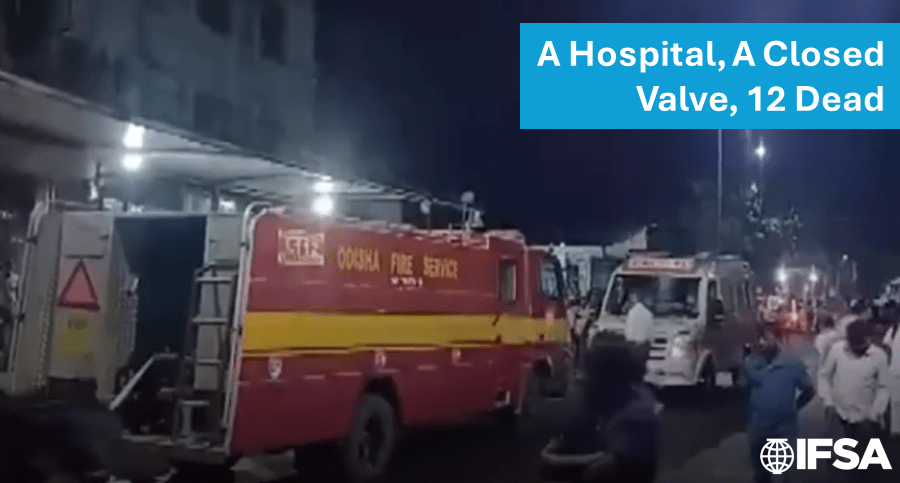 maintenance, repairs, or renovations. Unplanned impairments — like a valve left closed after servicing — are among the most dangerous conditions a building can face, precisely because no one knows the protection is gone.
NFPA 25, the Standard for the Inspection, Testing, and Maintenance of Water-Based Fire Protection Systems, provides a rigorous framework for managing impairments. It requires that any time a system is taken out of service, a formal impairment coordinator be designated, notifications be made to the authority having jurisdiction, a fire watch be established, and written documentation be maintained throughout. It mandates that all valves controlling water supply to sprinkler systems be supervised — either through electronic tamper switches, physical locks, or seals — so that a closed valve cannot go undetected.
NFPA 25 is not enforced in India. The SCB Medical College and Hospital was not required to follow its procedures. But had those procedures been in place, the valve closure would have triggered an immediate supervisory alarm. The disabled fire alarm would have been captured in an inspection log. A fire watch would have been in effect. Lives would likely have been saved.
India has the Codes. The Gap is in Maintenance.
It would be a mistake to frame this as a regulatory gap in the conventional sense. India has some of the most robust fire and building codes in the world. The National Building Code and Bureau of Indian Standards provide substantive requirements for fire protection system design and installation. The gap at SCB was not in what the codes require — it was in what happens after the system is installed and inspected for the last time. Ongoing service, routine inspection, and disciplined impairment management are where the distance between code and practice is widest, and where lives are most at risk.
India’s own institutions appear to recognize this. In the weeks following the fire, a team led by the National Disaster Management Authority conducted a site inspection to examine the lapses. The Orissa High Court has since stepped in, demanding status reports on the judicial probe ordered by Chief Minister Mohan Charan Majhi. Four officials — including fire officers and an electrical engineer — have been suspended. The accountability mechanisms are working. The hard work is ensuring the conditions that made this tragedy possible are not replicated across the thousands of healthcare facilities and public buildings that rely on fire suppression systems throughout the country.
Mr. Anik Dharamshi, Director of HD Fire Protect Limited and President of the Fire Protection Association of India, had this to say: “What happened in Cuttack may happen again unless India’s fire protection community closes the gap between code and practice. India has some of the most robust fire and building codes in the world — but a sprinkler valve left closed and a fire alarm left disabled reveal where the real challenge lies. Installation is not enough. Ongoing inspection, testing, and maintenance are what make a fire protection system worth having.”
This is Not an Isolated Incident
NFPA research consistently identifies closed supply valves as the leading cause of sprinkler system failures in fires where sprinklers were present but did not operate. A closed valve is not a rare fluke. It is the most common failure mode in the industry — and it is almost always the result of inadequate inspection, testing, and maintenance practices.
In the years since IFSA was founded, our affiliated associations have worked across six continents to advance education, regulatory standards, and industry integrity in water-based fire suppression. The SCB tragedy is a sobering reminder of what is at stake when that work is not yet complete, and of what can happen when fire protection systems are treated as installed-and-forgotten rather than living, maintained systems requiring ongoing care.
A Call to Action
If you are responsible for a building with a water-based fire protection system, there are three things you can do right now.
First, confirm that every control valve in your system is in the open position and properly supervised. Walk the system. Verify the position of every OS&Y valve, butterfly valve, and post indicator valve. If you are not certain, call your service contractor today.
Second, confirm that your fire alarm system is operational. An alarm that has been disabled — even temporarily, even for a “good reason” — is an alarm that cannot save lives. Restore it to service or document and manage the impairment formally.
Third, know your impairment management procedure. Whether or not your jurisdiction enforces NFPA 25, its impairment management requirements represent best practice. Adopting them costs nothing and could save everything.
The twelve patients who died at SCB Medical College and Hospital deserved the protection they were promised when those systems were installed. So do the occupants of every building in your care.
Inspect your systems. Maintain your systems. Supervise your valves. The alternative is unacceptable.