
The 2026 edition of NFPA 25 introduces a provision that represents a meaningful advancement in life-safety protection for hotels and condominiums. Rather than viewing this change as a burden, the industry should recognize it as a performance upgrade that significantly improves sprinkler responsiveness and enhances both personal safety and property protection in sleeping occupancies. As buildings constructed in the 1960s and 1970s reach the 50-year mark, NFPA 25 ensures their fire protection systems continue to meet modern standards.
Section 5.3.1.1.1.7 requires that when sprinklers have been installed for 50 years in dwelling units, one of two actions must occur: the sprinklers must be replaced with listed fast-response sprinklers, or representative samples must be tested to confirm that the Response Time Index, RTI, does not exceed 65 (ms)½. This is not simply an age-based replacement trigger; it is a performance benchmark. The requirement ensures that sprinklers in dwelling units activate at speeds consistent with modern fast-response technology, improving the ability to control fire growth at the earliest possible stage.
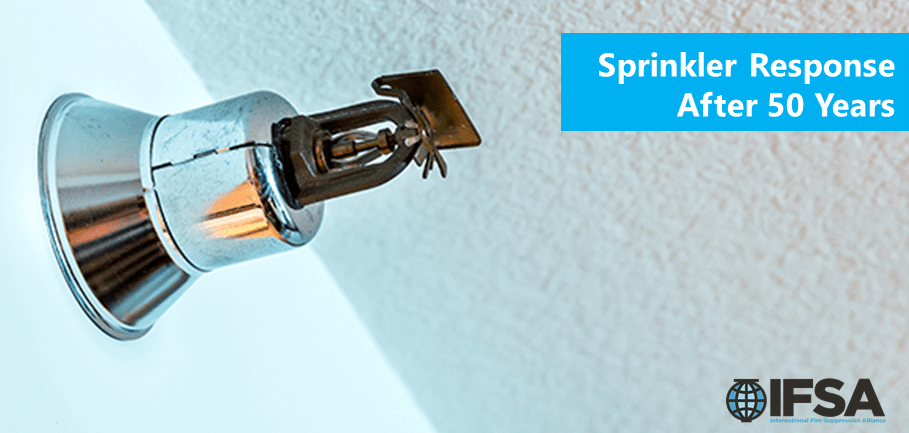
Sprinkler Responsiveness
Fast-response sprinklers are designed with lower thermal inertia, meaning they activate more quickly when exposed to heat. Earlier activation leads to faster fire control, lower heat-release rates, reduced smoke production, improved tenability for occupants, and a lower likelihood of flashover. In hotels and condominiums, where occupants may be asleep or unfamiliar with the building layout, early intervention is critical. Faster sprinkler activation directly improves survivability while also limiting fire damage. This provision strengthens the performance profile of legacy systems and aligns them with current life-safety science.
Importantly, this update does not introduce a new concept. It aligns older systems with standards that have been in place for decades. NFPA 13 has required fast-response sprinklers in light-hazard occupancies since 1996. For nearly 30 years, newly designed hotel and residential systems have been built with faster-activating sprinklers as the baseline expectation. The NFPA 25 update simply ensures that older installations benefit from the same advancements in sprinkler technology, effectively closing a generational gap in system performance.
Hotels and condominiums are not static assets. Hotels typically undergo soft-goods refreshes every five to seven years, full-room renovations every ten to twelve years, and major repositioning every fifteen to twenty years. Condominiums follow capital improvement cycles driven by reserve studies, ownership turnover, and modernization projects. Coordinating sprinkler upgrades with planned renovations presents a strategic opportunity. Ceiling access is already scheduled, rooms may be temporarily out of service, and capital improvements are budgeted. Rather than being disruptive, sprinkler replacement can be integrated efficiently into long-term asset management planning.
This update benefits multiple stakeholders. For occupants, faster activation improves survivable conditions and limits fire growth earlier. For owners, improved responsiveness reduces potential loss severity and aligns with modern risk management expectations. For insurers and risk professionals, enhanced sprinkler performance reduces the probability of high-loss events. This is not merely a compliance adjustment; it is a measurable enhancement in building resilience.
Buildings constructed before the mid-1970s are now reaching a natural lifecycle milestone. Over five decades, finishes, furnishings, HVAC systems, elevators, and lighting have likely been upgraded multiple times. NFPA 25, 2026 edition, ensures that sprinkler responsiveness evolves as well. It reinforces a clear industry principle: sprinklers in dwelling units are life-safety systems first, and their performance must reflect current knowledge and expectations. Viewed through that lens, this provision represents progress. It strengthens occupant protection, enhances property resilience, and aligns legacy systems with nearly three decades of fast-response expectations under NFPA 13, helping ensure dependable fire protection performance for the next generation.