
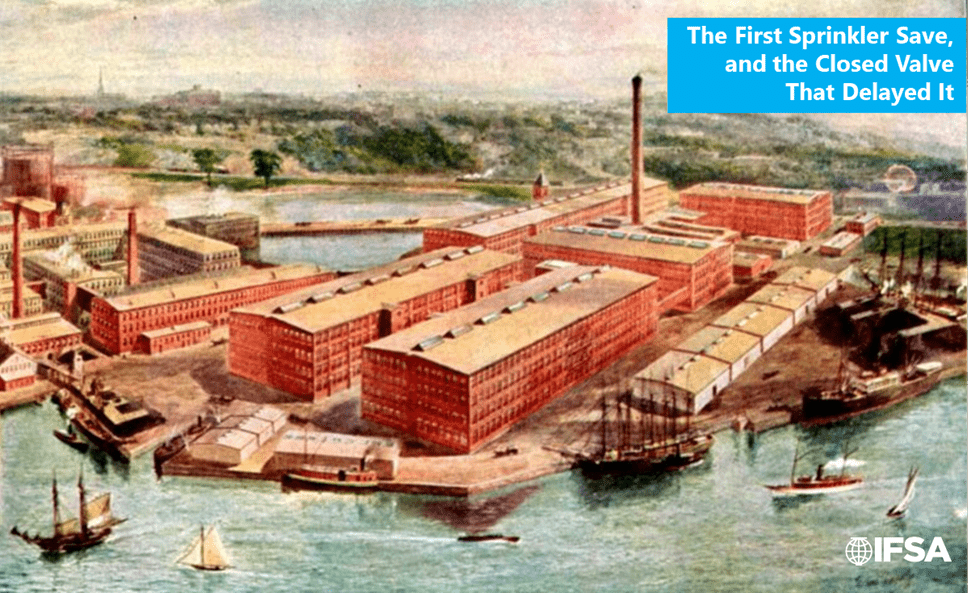
First Sprinkler Save
On February 12, 1877, a fire broke out in the picker room of the American Linen Company in Fall River, Massachusetts. The mill was protected by one of the earliest automatic sprinkler systems, developed through the collaboration of Henry Parmelee and Frederick Grinnell, and the incident became the first known documented case of an automatic sprinkler extinguishing a fire. However, the historical record includes an important detail that still resonates today: the water supply was shut off at the time of the fire and had to be turned on before the sprinklers could operate. Only after someone located and opened the system valve did water discharge and suppress the fire. In other words, the very first recorded sprinkler save was delayed by a closed valve.
One hundred and fifty years later, this same issue persists. While modern sprinkler systems are more sophisticated, engineered, and dependable than those of the 1870s, closed control valves remain one of the leading causes of system failure. NFPA data consistently show that when sprinkler systems do not operate as intended, a frequent reason is that the water supply has been shut off. Valves may be intentionally closed for maintenance and not reopened, inadvertently shut during renovations or construction, or left unsupervised. The technology has advanced significantly, yet the vulnerability remains rooted in human behavior.
Automatic sprinklers are designed to function without human intervention at the point of fire, but they remain dependent on proper system oversight. A sprinkler system with a closed valve is an impaired system. Questions must continually be asked: Was the control valve left open? Is it electronically supervised? Are inspections conducted in accordance with NFPA 25? Are impairments properly documented and managed? The 1877 incident reminds us that fire protection is not solely about product performance, it is about system integrity. Certified and listed components mean little if the water supply is unavailable.
Today’s codes and standards clearly require that control valves be supervised or secured in the open position and that impairments be properly managed. These are not administrative formalities, they are lessons written into code through decades of fire experience. Modern systems benefit from tamper switches, remote monitoring, and integrated building management systems, yet closed valves continue to appear in loss investigations because fire protection systems are often out of sight and out of mind. Effective protection demands discipline, documented impairment procedures, clear responsibility between owners and contractors, routine verification of valve status, and training for maintenance personnel. Sprinklers are automatic, but oversight is not.
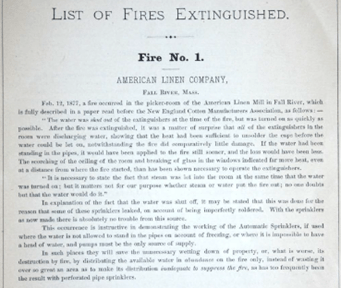 From an IFSA perspective, certification, regulatory alignment, and global education are essential pillars of effective fire protection, but certification alone does not guarantee performance. A fully certified sprinkler system that has been impaired through a closed valve offers no protection. System integrity requires certified components, proper design and installation, a dependable water supply, ongoing inspection and testing, and accountable ownership. The 1877 fire in Fall River is more than a historical anecdote, it is a reminder that fire protection effectiveness depends equally on engineering and execution.
The American Linen Company incident demonstrated the life-safety and property-protection potential of automatic sprinklers. Even with the delay caused by the closed valve, the fire was extinguished before it could spread. That lesson remains just as relevant today. Automatic sprinklers are designed for early intervention, limiting heat release, reducing smoke production, and preventing flashover. When water is delayed or unavailable, that window of opportunity narrows rapidly. Closed valves transform a dependable life-safety system into a decorative pipe network.
The first recorded sprinkler save should inspire pride in the industry, but it should also reinforce responsibility. Manufacturers, contractors, inspectors, fire officials, insurers, and building owners all share accountability in ensuring systems are not only installed, but ready. Valve supervision must be verified, impairment procedures strengthened, training reinforced, and valve status treated as mission critical. One hundred and fifty years ago, someone had to run and open a valve to make the system work. In 2026, there is no excuse for not knowing whether a system is ready to perform. Fire protection begins with water, and water begins with an open valve.