
What do the products in the picture have in common? They are not what they appear. They are not safety devices; they are all security cameras.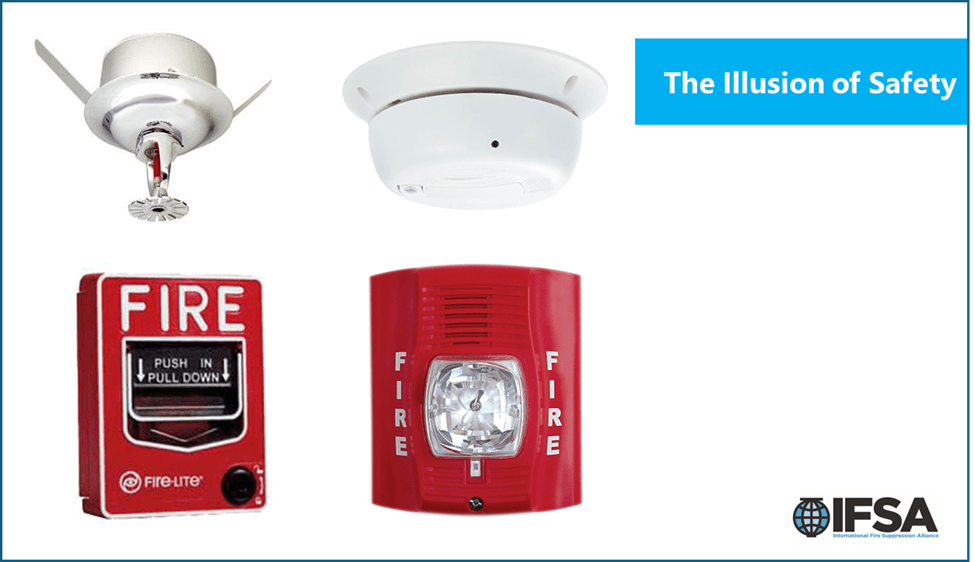
Across commercial buildings, residential occupancies, hospitality properties, and educational facilities, devices resembling fire sprinkler heads are increasingly being installed as concealed cameras. Marketed as discreet surveillance tools, these products share a critical characteristic: they are not what they appear to be. They are not part of a listed fire protection system; they are not connected to a water supply; they do not respond to heat; and they perform no fire control or fire safety function whatsoever. Their installation is not simply misleading — it is prohibited by code.
The 2024 edition of the International Fire Code is unambiguous on this point. Section 901.4.6 prohibits any device that has the physical appearance of life safety or fire protection equipment but does not perform that function. The NFPA 5000 Building Construction and Safety Code contains nearly identical language in Section 56.11.5.4. The intent of both codes is clear: if a device looks like fire protection equipment but does not function as such, it is not permitted.
Some may dismiss these products as harmless aesthetic choices, but the implications extend well beyond appearance. Occupants instinctively assume that visible fire protection equipment is operational and part of a functioning system. When a device visually mimics a sprinkler head, it creates an expectation of coverage and suppression capability that simply does not exist. In an emergency, that false assumption can distort behavior and undermine confidence in the system’s integrity. Life safety depends on clarity and trust — and imitation devices erode both.
The global fire sprinkler industry has operated for over 125 years on a straightforward principle: fire protection systems must be certified, listed, properly installed, and maintained in accordance with standards such as NFPA 13 and NFPA 25. When imitation devices are installed in protected spaces, the system’s visual credibility is weakened—and occupants should never have to question whether a sprinkler is real.
The prohibitions in the IFC and NFPA 5000 reflect a broader life-safety imperative: life-safety devices must be unmistakable and dependable. Fire alarm pull stations must activate alarms. Exit signs must indicate egress. Sprinklers must discharge water when exposed to heat. Any device that mimics these appearances without delivering the associated function introduces ambiguity into systems designed to be unequivocal. In life safety, ambiguity is unacceptable.
Building owners bear responsibility for maintaining code compliance and should consult the authority having jurisdiction before installing any device that resembles fire protection equipment. Design professionals and contractors must exercise due diligence and avoid incorporating equipment that compromises system clarity. Authorities having jurisdiction have clear enforcement power under the 2024 code language to prohibit these installations outright.
A camera disguised as a sprinkler is not a creative design solution. It is a prohibited device. When equipment looks like protection, it must provide protection. Anything less undermines trust, compliance, and the integrity of the life safety system.