
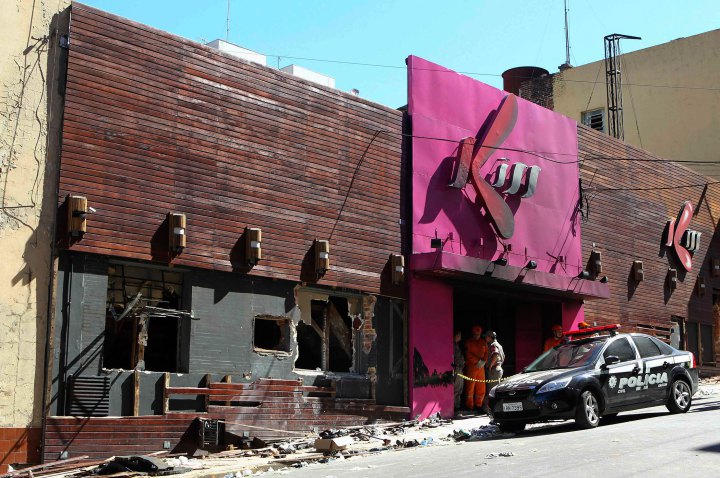
 In the early morning hours of January 27, 2013, a fire at the Kiss Nightclub in Santa Maria, Brazil, resulted in one of the deadliest nightclub fires in modern history. The incident claimed 234 lives and injured hundreds more, sending shockwaves through Brazil and the international fire-safety community. Subsequent investigations confirmed that the overwhelming majority of fatalities were caused not by burns, but by toxic smoke inhalation, primarily carbon monoxide and hydrogen cyanide.
The Kiss fire stands as a stark reminder that nightclub-type occupancies—regardless of country—share a common risk profile: dense crowds, alcohol-impaired occupants, combustible interior finishes, and limited margins for error once fire begins.
Fire Origin and Combustible Interior Materials
The fire was ignited when indoor pyrotechnics used during a live performance contacted polyurethane acoustic foam installed near the stage. The foam ignited almost immediately, producing dense, toxic smoke, and rapid fire spread across the ceiling and upper wall surfaces. This ignition scenario mirrors conditions documented in multiple nightclub fires worldwide and aligns closely with findings from the National Institute of Standards and Technology (NIST) investigation of the Station Nightclub fire. NIST’s research demonstrated that certain foam plastic sound-damping materials can ignite easily and generate extreme heat release and toxic smoke in a matter of seconds—dramatically reducing available safe egress time.
The Kiss fire confirmed that these hazards are not theoretical. When combustible acoustic materials are present, a small ignition source can rapidly overwhelm an enclosed assembly space.
Smoke Toxicity and the Loss of Tenable Conditions
Medical and forensic analysis of the Kiss fire revealed a consistent pattern: occupants were incapacitated by smoke long before flames blocked escape routes. Many victims exhibited little or no external burn injury, indicating collapse due to hypoxia and toxic gas exposure while attempting to evacuate.
NIST research into nightclub fire dynamics has repeatedly emphasized that smoke toxicity—not flame contact—is the dominant life-threatening hazard in these environments. Synthetic foams and furnishings common to nightclubs produce lethal gases early in fire development, often before occupants recognize the severity of the event.
In Santa Maria, smoke spread so rapidly that tenable conditions throughout much of the nightclub deteriorated in just a few minutes, leaving occupants with insufficient time to locate exits or navigate congestion.
Occupant Load, Alcohol, and Human Behavior
At the time of the fire, the Kiss Nightclub was severely overcrowded, with estimates exceeding 1,000 occupants—far beyond its intended capacity. Alcohol consumption, low lighting, loud music, and theatrical effects delayed recognition of danger and slowed response.
Human behavior observed during the Kiss fire aligns closely with findings from NIST evacuation studies:
- Occupants tended to move toward familiar entrances rather than alternative exits
- Groups attempted to stay together, increasing hesitation and congestion
- Disorientation caused some occupants to move into non-egress spaces, including restrooms
These behaviors are not anomalies; they are expected responses under stress and impairment. Modern fire-safety design must account for them, not assume ideal evacuation.
Egress Constraints and Exit Control
The Kiss Nightclub effectively relied on a single main exit. Compounding the problem, security staff initially restricted exit flow—consistent with normal nightclub operations but catastrophic during a fire.
Post-incident egress modeling demonstrated that even short delays at the exit dramatically increased fatality rates, and that once smoke conditions worsened, occupants were physically unable to continue moving. The modeling showed that survivability hinged on early access to exits before smoke spread—not on exit width alone.
The Role of Active Fire Protection Systems
One of the most consequential factors in the Kiss Nightclub fire was the absence of automatic sprinkler systems.
NIST’s nightclub fire research, including modeling performed for the Station Nightclub investigation, has consistently shown that automatic sprinklers capable of controlling fire growth early can dramatically alter outcomes in nightclub-type occupancies. By limiting heat release and slowing fire development near the point of origin, sprinklers reduce the rate of smoke and toxic gas production, preserving tenable conditions longer.
In the context of the Kiss fire, early fire control could have:
- Slowed smoke spread across the ceiling
- Reduced toxic gas concentration during the critical early minutes
- Preserved visibility and breathable air along egress paths
- Extended the time available for evacuation
Importantly, the value of sprinklers in nightclubs is not dependent on complete extinguishment. Their primary life-safety function is fire control—buying time when human performance is most compromised.
Detection, Alarm, and Time Compression
The Kiss Nightclub also lacked effective fire detection and alarm systems. Without early warning, occupants relied on sensory cues—smell, irritation, and visual smoke—to recognize danger. By the time those cues were unmistakable, tenable conditions were already collapsing.
NIST has repeatedly emphasized that detection and alarm alone are insufficient in nightclub environments. Without active fire protection to control growth, notification simply starts the clock—it does not slow it.
A Global Systems Failure, Not a Local One
The Kiss Nightclub fire was not the result of a single regulatory gap or cultural failure. It was the convergence of:
- Combustible interior finishes
- Indoor pyrotechnics
- Overcrowding and alcohol impairment
- Inadequate egress and exit control
- Absence of active fire protection systems
These same factors have been identified in nightclub fires across multiple continents. Fire behaves differently in every building—but the loss of tenable conditions in nightclub environments is consistently unforgiving when early fire control is absent.
Implications for the Global Fire-Safety Community
For IFSA and its global stakeholders, the Kiss Nightclub fire reinforces several critical principles:
- Interior materials matter as much as structural design
- Smoke toxicity must be treated as the primary life-threatening hazard
- Human behavior under impairment must be assumed—not idealized
- Evacuation alone cannot be relied upon
- Active fire protection systems are essential to preserving time and tenability
These lessons align directly with decades of NIST research and remain central to advancing life safety in assembly occupancies worldwide.
Conclusion
The Kiss Nightclub fire stands as a painful reminder that in high-density entertainment venues, seconds decide survival. When fire growth and smoke production are not controlled early, even well-intentioned evacuation efforts can fail.
By integrating the lessons of Santa Maria with NIST’s scientific research on nightclub fire behavior, the path forward becomes clear: preventing future tragedies requires not only awareness and enforcement, but robust active fire protection systems designed to control fire growth and preserve tenable conditions when people need them most.
For the global fire-safety community, the responsibility is ongoing—and the lessons remain urgent.