
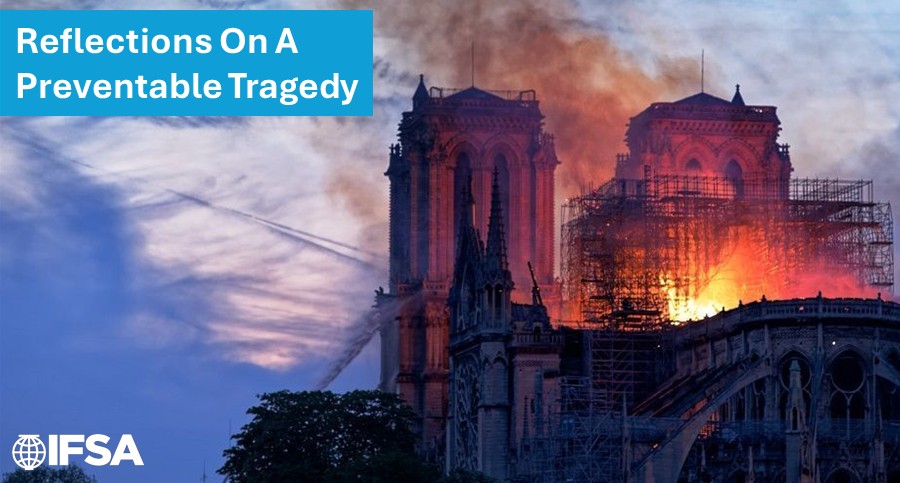
 “Notre-Dame is our history, our literature, part of our imagination. The place where we experienced all our great events … It’s the epicenter of our life.” — President Emmanuel Macron, April 15, 2019
Seven years ago, the world watched in stunned silence as the spire of Notre-Dame Cathedral collapsed into the Paris skyline, trailing a column of sparks and centuries of irreplaceable heritage. This was preventable.
Notre-Dame was not unique in its vulnerability. Across the globe, thousands of historic structures — cathedrals, museums, cultural centers, places of worship — remain dangerously under-protected against fire. The cathedral’s April 15, 2019, fire cost the world an estimated $8 billion in damage, the destruction of its iconic spire, and the irreversible loss of priceless artifacts and architectural fabric. And Notre-Dame was not the first. Just seven months earlier, a fire tore through Brazil’s 200-year-old National Museum in Rio de Janeiro, incinerating vast collections of artifacts representing that nation’s entire cultural, natural, and scientific heritage. President Michel Temer called the loss “incalculable.”
These disasters share a thread: historic properties whose extraordinary cultural value was not matched by adequate investment in fire protection.
Why Historic Structures Are Uniquely Vulnerable
The challenges of protecting culturally significant properties are real, complex, and often underestimated. These buildings were constructed long before modern fire codes existed. Their electrical systems are frequently antiquated. Their structural materials — centuries-old timber, stone vaulted ceilings, ornate wooden furnishings — are highly combustible and difficult to protect without compromising historical integrity. Hot work during renovation (the probable cause of Notre-Dame’s fire), faulty heating systems, lightning, arson, and simple human error all represent credible threats in environments where the margin for error is zero.
Common ignition risks in historic and culturally significant properties include:
• Outdated Electrical Systems: Aging wiring and overloaded circuits that have never been brought to modern safety standards.
• Renovation and Hot Work: Welding, cutting, and grinding operations in buildings filled with centuries-old combustible materials — the likely trigger at Notre-Dame.
• Heating Equipment: Furnaces and boilers improperly maintained or upgraded in ways incompatible with historic structures.
• Lightning: Tall towers, spires, and steeples are particularly exposed, and historic structures rarely have modern lightning protection.
• Human Error and Arson: Open flames, candles, improperly discarded smoking materials, and deliberate acts all represent ongoing threats.
• Natural Disasters: Wildfire, flood, and storm damage can cascade into fire events that overwhelm unprepared sites.
The Tools We Have and Are Not Using
This is what frustrates fire protection professionals most: the tools exist. The codes are written. The technology is proven. What is lacking is the commitment to deploy them.
The National Fire Protection Association’s NFPA 909 (Code for the Protection of Cultural Resource Properties) and NFPA 914 (Code for the Protection of Historic Structures) provide detailed, practical frameworks for protecting these sites. These are not aspirational documents — they are actionable blueprints.
Automatic fire sprinkler systems, designed to be discreet or fully concealed to avoid altering historical aesthetics, can control fires in their earliest stages—often before any visible structural damage occurs. Water mist and hybrid water mist systems offer a particularly compelling option for museums and spaces housing irreplaceable artifacts, as they deliver protection with less water runoff than traditional sprinklers. Gaseous suppression systems provide an alternative where water is simply not viable. Water spray systems protect exterior facades and prevent the spread of fire to neighboring structures.
For detection and early warning, modern systems can be tuned to the specific sensitivities of a historic space, providing alerts that give emergency responders critical extra minutes — the difference, as we saw in Paris, between a damaged roof and a lost cathedral.
What Notre-Dame had on the night of April 15, 2019, was a fire detection system and a delay in acting on its alarm. It did not have an automatic fire protection system. That gap is indefensible in retrospect, and it should be unacceptable going forward.
A Framework for Action
Protecting a historically significant property begins with honest risk assessment — not a cursory walkthrough, but a rigorous, systematic examination of the building’s construction, occupancy, hazards, and vulnerabilities. From that foundation, stewards of these properties should work with qualified fire protection engineers to develop a layered protection strategy: passive measures like compartmentation to contain fire spread, active detection and suppression systems calibrated to the site’s specific needs, and comprehensive emergency planning that ensures staff and local fire departments are prepared to respond effectively.
Preservation and protection are not opposing values. Modern fire protection systems can be installed with extraordinary sensitivity to historic fabric. The question is never whether we can protect these buildings — it is whether we choose to.
Seven Years Later: A Call to Action
The restored Notre-Dame Cathedral welcomed the world back in December 2024, a testament to human determination and the depth of our attachment to shared cultural heritage. But the lesson of April 15, 2019, will only be fully learned when the thousands of historic structures still operating without adequate fire protection receive the investment they require.
At IFSA, our mission is to globally promote the use of effective water-based fire protection systems. We work with industry partners, standards bodies, and regional associations across six continents to advance that mission. The anniversary of Notre-Dame’s fire is a moment to recommit to that work and to remind owners, stewards, policymakers, and the public that the heritage we love can only be preserved if we are willing to protect it. The next Notre-Dame should never happen. The tools to prevent it are in our hands.