
The lithium-ion (Li-Ion) battery market is expanding at a pace that continues to outstrip the development of the codes and standards designed to govern it. From residential e-bikes to utility-scale Battery Energy Storage Systems (BESS), Li-Ion technology is now embedded in virtually every sector of the built environment — across every continent and jurisdiction. For fire protection professionals and contractors worldwide, that proliferation has created a fast-moving and technically demanding set of design challenges, one that demands a firm grasp of both the underlying hazard science and the current state of prescriptive and performance-based requirements. While the referenced codes and standards reflect the US regulatory environment, the underlying hazard science, design principles, and testing protocols are globally applicable and are increasingly referenced by authorities having jurisdiction worldwide.
The Core Hazard: Thermal Runaway
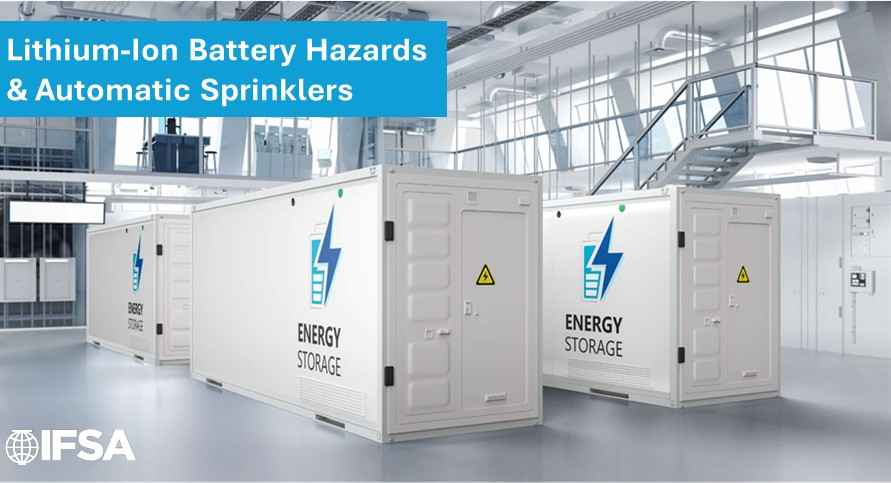 Before tackling design criteria, it is essential to understand what fundamentally distinguishes Li-Ion batteries from conventional fire hazards. The primary risk is thermal runaway — defined by NFPA 855 as the condition in which an electrochemical cell increases its temperature through self-heating in an uncontrollable fashion, potentially leading to off-gassing, fire, or explosion.
Unlike a traditional Class B or Class C fire, thermal runaway is an internal electrochemical event. Once initiated, it cannot be stopped by a suppression system. The fire tetrahedron does not directly apply; removing oxygen from the atmosphere does not halt thermal runaway — it merely prevents ignition of the combustible gases being released, which can then accumulate to deflagration concentrations. This is a critical design consideration that immediately disqualifies certain suppression technologies, particularly those that deprive a compartment of oxygen.
Thermal runaway can be triggered by thermal abuse (overheating or loss of cooling), electrical abuse (overcharging or overdischarging), or physical damage to the cell. Once a single cell enters thermal runaway, propagation to adjacent cells is highly probable unless adequate separation or active cooling is in place.
The practical implication for sprinkler design: the goal of a fire sprinkler system protecting Li-Ion batteries is not extinguishment of the thermal runaway event itself — it is containment. The system must cool adjacent cells sufficiently to limit propagation to the rack, shelf, or vehicle where the event originated. This principle holds regardless of which national or regional code framework governs a given project.
Battery Chemistry and State of Charge Matter
Not all Li-Ion batteries present the same hazard profile. The chemical composition of the cathode material significantly affects both energy density and the severity of thermal runaway. Common chemistries include Lithium Nickel Manganese Cobalt Oxide (NMC), Lithium Iron Phosphate (LFP), Lithium Nickel Cobalt Aluminum Oxide (NCA), and Lithium Cobalt Oxide (LCO), among others.
Research from Sandia National Laboratories illustrates that while greater stored energy correlates with greater total thermal runaway enthalpy, batteries with higher specific energy release that energy faster and at greater peak heat release rates. NMC and NCA chemistries carry a higher energy density than LFP but produce more severe thermal runaway events. The battery chemistry present in a given installation directly influences the appropriate protection criteria — professionals should not assume a one-size-fits-all approach, regardless of jurisdiction.
State of Charge (SOC) is equally relevant. A cell at 100% SOC will undergo a significantly more violent thermal runaway than an identical cell at 30% SOC, with measurably higher peak temperatures, peak heating rates, and enthalpy of runaway. SOC thresholds — typically 60% are used in several frameworks, including FM Global’s data sheets, to define storage commodity classifications and determine applicable design criteria. Understanding the operational SOC of a given installation is therefore a material design input, not a secondary consideration.
The Regulatory Landscape: Where Do Requirements Come From?
Unlike most commodity hazards, there is no single global prescriptive document that covers Li-Ion batteries across all applications. Even within the US framework, design criteria must be drawn from multiple overlapping sources depending on the specific use case. Internationally, the picture is even more varied, though the underlying testing protocols — particularly UL 9540A — are increasingly referenced by regulators and authorities having jurisdiction beyond North America.
NFPA 13 explicitly excludes Li-Ion batteries from its scope for sprinkler design purposes. The installation requirements still apply, but the design densities and areas must be sourced elsewhere.
NFPA 855 is the primary US standard for stationary energy storage systems. For compliant indoor commercial installations — where ESS groups do not exceed 50 kWh each, separated by at least 3 feet — the prescribed sprinkler density is 0.3 gpm/sqft over 2,500 square feet. Non-dedicated-use buildings are capped at 600 kWh per fire area; dedicated-use buildings carry no such energy limit, provided appropriate fire-rated separations and occupancy restrictions are maintained. Where an arrangement does not meet NFPA 855’s prescriptive thresholds, large-scale testing per UL 9540A is required.
FM Global Data Sheet 5-33 governs Li-Ion BESS installations greater than 20 kWh and specifies location-based criteria that vary by proximity to exposures, number of accessible exterior walls, and battery chemistry. NMC installations require greater aisle separations than LFP installations. When location requirements are satisfied, the sprinkler density is also 0.3 gpm/ft² over the entire fire area, with a 45-minute water supply duration for each adjacent unseparated battery rack.
FM Global Data Sheet 7-112 is the primary reference for bulk battery storage, providing commodity classifications based on SOC, ceiling height, storage height, and packaging, which feed into FM Data Sheet 8-9 for applicable sprinkler design criteria.
These US-origin documents are widely consulted in global markets — particularly for multinational manufacturing, logistics, and energy storage projects — making familiarity with them professionally relevant far beyond North America.
UL 9540A: The Performance-Based Path
For most large-scale ESS installations, the prescriptive path is not economically viable — the energy density limitations make the cost per square foot prohibitive. As a result, the majority of commercial projects involve a performance-based design validated through UL 9540A testing, a protocol that has gained significant international traction as the benchmark methodology for evaluating thermal runaway fire propagation in battery energy storage systems.
UL 9540A is a tiered test protocol with four levels: Cell, Module, Unit, and Installation. Each level subjects the battery system to a forced thermal runaway event and evaluates whether propagation is contained within the design boundary. If a given level passes, no further testing is required. The installation-level test — the most relevant to fire protection system design — evaluates the effectiveness of the intended suppression arrangement, either through sprinkler systems designed at 0.3 gpm/sqft (Method 1) or through an alternate fire protection plan (Method 2).
Contractors and designers involved in ESS projects anywhere in the world should be conversant in UL 9540A results, as manufacturer test reports will often dictate the applicable sprinkler design criteria, nozzle placement, and system type required for a given installation configuration.
Application-Specific Considerations
Electric Vehicles and Parking Structures: EV adoption is accelerating globally, and with it comes the challenge of protecting parking structures that house vehicles with large-format Li-Ion battery packs. Research data consistently demonstrates that sprinkler-protected parking structures have successfully contained EV fires to the immediate fire area. In the US, NFPA 13 has elevated the recommended occupancy classification for parking garages to Ordinary Hazard Group 2, and NFPA 88A now requires sprinklers in all parking structures including previously exempt open garages. Similar reassessments of parking structure protection criteria are underway in multiple international markets.
Micro Mobility Devices: E-bikes, scooters, hoverboards, and similar devices represent a rapidly growing residential exposure globally. These devices are frequently charged in egress paths and living spaces, often with compromised or uncertified battery packs. The pattern of incidents is not unique to the US; fire services across Europe, Asia, and Australasia have reported similar trends as micro mobility adoption has accelerated, driving regulatory attention in multiple jurisdictions.
Bulk Battery Storage: With prescriptive guidance largely absent from installation standards like NFPA 13, FM Data Sheet 7-112 is the most detailed available reference. Professionals engaged in warehouse or distribution center work involving consumer electronics, battery modules, or finished battery-powered products must be prepared to engage FM requirements or develop a performance-based design with full-scale test support.
The Bottom Line for Practitioners
Li-Ion battery protection is not a niche specialty — it is rapidly becoming a core competency for fire protection professionals across virtually every market segment and every region of the world. The codes and standards are actively evolving, and the gap between what technology demands and what prescriptive criteria currently provide remains significant.
Practitioners should approach these projects with an understanding that prescriptive solutions may not be available for a given configuration, that chemistry and SOC are material design inputs, and that large-scale testing data — whether from UL 9540A reports or equivalent methodologies — will often be the determining factor in establishing an acceptable system design. For professionals working across multiple jurisdictions, building fluency with both the US-origin frameworks and the emerging standards activity in your own markets will be essential.
The IFSA exists to connect fire sprinkler professionals across borders and advance the science and practice of fire sprinkler protection globally. As Li-Ion battery technology continues to reshape the risk landscape in every market we serve, staying ahead of this hazard class is squarely within our collective mission.